Tuesday, 1 March 2011

NSS Kids’ Fun with Nature Photography

By Gloria Seow, Education Group Chairperson
Photos by Lena Chow


Auntie Gloria gave a brief introduction to the basic functions of the digital camera.


Equipping kids as young as four years old with basic nature photography skills was not as easy as anticipated. These frisky little ones had great difficulty staying still long enough to snap a decent shot. Concepts like ‘framing’, ‘focusing’, and ‘macro’ were somewhat lost on them. Still they had fun running around capturing pictures of plants, insects, and other wildlife, as well as scenery. The older kids benefitted more from the nature walk cum photography session held at the MacRitchie Reservoir on 18 December 2010.


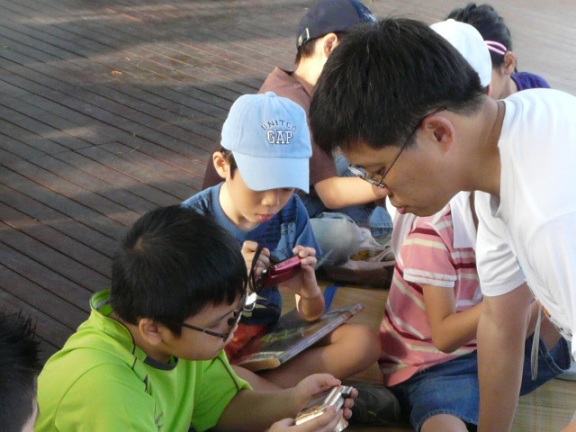
Every child had his own point-and-shoot camera.


Nature shots taken can be uploaded online to be shared with friends. This event was earlier highlighted in The Straits Times as part of a line-up of kids’ nature activities happening during the school vacation. As such, we had a deluge of registrations with up to 80 children wanting in on the action. In the end, 33 kids showed up together with an entourage of parents and caregivers.


Auntie Gloria gave a brief introduction to the basic functions of the digital camera. All kids present brought their own point-and-shoot devices. We then broke up into five groups led by Auntie Gloria, Auntie Lena, Auntie Mabel, Uncle Hang Chong and Uncle Timothy.


Auntie Mabel’s troop of older kids got to photograph carnivorous Slender Pitcher Plants, frolicking Long-tailed Macaques and soaring White-belled Sea Eagles. With his years of experience as a nature guide, Uncle Hang Chong naturally regaled his impressionable charges with nature stories and factoids while they snapped away at their subjects. Auntie Lena discovered that Singapore’s flies, if one cared to look at them at all, were a colourful lot, ranging from luminescent green to funky pink.


“Welcome to my lair,” said Mr Spider.


Uncle Timothy pointed out aspects of nature that one would normally miss, such as moss and lichen growing along pavement cracks, helping the kids appreciate these tiny life forms. By capturing close-up shots of what appears small and insignificant at first glance, one is usually surprised to find out that they are actually quite complex and beautiful.


While photographing a flowering shrub, Auntie Gloria’s group stumbled across two Green-crested Lizards resting amongst the foliage, right under our noses. These retiring lizards have been largely displaced by the invasive and non-native Changeable Lizard in many parts of Singapore. As such, it was our privilege that they turned up as perfect models for us. Flowers such as this Ixora were a favourite macro subject.


Being an excitable lot, the kids had to be constantly reminded not to get too close to animals, lest they flee or attack - their first lesson in nature photography etiquette. Indeed, we learnt that a nature trip can be enhanced by taking away memories of it in the form of photographs. Given today’s connectivity, these images can be uploaded almost instantaneously onto social media websites such as Facebook, as well as blogs and other online platforms. Sharing our nature shots with others is the best way to showcase Singapore’s Amazing Wildlife. This little step can help people realise that Singapore’s natural heritage is indeed diverse and wonderful, and ultimately, worth conserving. Uncle Timothy tutoring individual kids.
Monday, 31 January 2011

Fun with Nature Sketching and Origami

By Gloria Seow, Education Group Chairperson


The scenic granite backdrop of Bukit Batok Nature Park formed the perfect outdoor setting for nature art.

The Education Group, together with Cicada Tree Eco Place, orchestrated a joint nature sketching cum origami workshop for kids and their caregivers. This took place at the Bukit Batok Nature Park on 3 October 2010. Nature artist and birding maestro Uncle Ding Li not only conducted the drawing session, but also complemented it with a fascinating commentary on Singapore’s ecology.

We started off with a stroll along a leafy path where we had delightful encounters with a small flock of White-crested Laughing Thrushes. These charismatic introduced birds were foraging at eye level, occasionally hopping along the forest floor or landing in low bushes. Everyone enjoyed good views even without binoculars. We also saw a lone Laced Woodpecker high up in the trees and heard the sparkling song of the globally-threatened Straw-headed Bulbul.


Kids working hard on their woodpecker masterpieces.

Auntie Vilma laid out a huge groundsheet facing the jagged granite outcrop of the pond area. This pretty setting suited the creation of dainty art pieces. Auntie Yue Yun, Auntie Lena and Uncle Timothy handed out recycled paper and sharpened pencils as drawing material. The kids were asked to recall the appearance of the White-crested Laughing Thrush. Uncle Ding then broke down the bird’s body structure into basic geometrical forms such as ovals (body), circles (head), triangles (beak) and rectangles (tail). Using these basic shapes, the children also drew their own birdies. Uncle Ding went on to erase off unnecessary lines to obtain a simple drawing of a perched bird. Just to prove that nature sketching could be done in a jiffy so as to capture the fresh memory of a recently-encountered bird, Uncle Ding went on draw a life-like laughing thrush in under three minutes!


Uncle Ding Li used basic shapes like ovals, circles, triangles and rectangles to sketch a bird, with the kids eagerly following suit.

Following this, Auntie Gloria handed out several articles related to nature sketching published in ‘Suara Enggang’, the birding bulletin of the Malaysian Nature Society. These articles explained the usefulness of nature sketching as a tool for observers to quickly note the key features of newly-encountered wildlife. Arrows with description can be added, denoting diagnostic features such as colour and even behaviour. These observations can be penned in a notebook carried along during field trips. Even those with long lenses could do with a pocketbook to record sightings and sketch those creatures that had evaded camera capture. Such field sketches, along with additional information such as date, time, place and weather condition, are frequently used as evidence to support rare sightings, thereby growing the body of scientific knowledge.


Uncle Ding Li drew this woodpecker in record time.

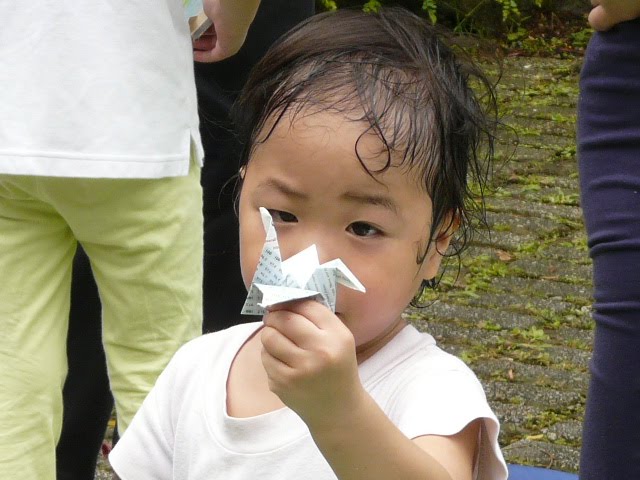
Uncle Ding led the kids further in a step-by-step sketch of the White-bellied Woodpecker and a butterfly. He explained that the White-bellied Woodpecker is feared to be extinct in Singapore with the last sighting occurring many moons ago. The children finished off their masterpieces by colouring them with magic pen. To round up the session, Auntie Yue Yun taught us how to fold a bird with movable body parts starting from a square piece of recycled magazine. Uncle Tim even ‘magnified’ the origami steps by demonstrating on a bigger sheet of paper. Soon enough, our paper birds were flapping merrily, much to the delight of the young ones.


Playing with an origami bird made of recycled magazine.

Monday, 18 October 2010

NSS Kids’ Fun at Green Circle Eco-Farm

By Gloria Seow, Education Group Chairperson
The pastoral expanse of Green Circle Eco-Farm.
Evelyn shared with us the intrigues and insights of farm life.

Despite the early morning showers on 29 August 2010, the weather turned out fine at Green Circle Eco-Farm where a hardy group of children and adults had gathered at 9 am. Farm co-owner Evelyn Eng-Lim was our informative guide who took pleasure in introducing us to the virtues of organic farming and permaculture in her green patch at Neo Tiew Road.

Evelyn began by sharing with us how she first came to start a farm some 11 years ago. As a nature conservationist and full-time NSS volunteer then, she had always been attracted to the idea of organic farming. The final push came when she learnt that the government had recently permitted farmers to stay on their farms, something that she and her husband Tian Soo really wanted. After tendering successfully, the first stage was to make lots of compost to condition and fertilise the soil. The compost took three months to mature. The second stage was to start planting. To do this, they had to clear the existing vegetation (mainly elephant grass as tall as a man), stage by stage and only for immediate use so as not to expose the soil to weathering. Digging the hard clayey soil to make (vegetable) beds was a tough job that needed skill. Miraculously, an eccentric guy in his early 50s showed up to help them. Within a couple of weeks, the elephant grass had disappeared, and beds with compost mixed in were ready for farming. Knowing nothing about growing fresh produce on a large scale, the couple engaged an organic farmer consultant from across the Causeway and soon their first crops were sown.

Running a farm is a strenuous affair, having to engage foreign workers, supervise volunteers, manage the daily operations and finances, deal with the occasional inconsiderate neighbour, and of course grow vegetables successfully. By living so close to the earth, Evelyn had little insights now and then to make farm life interesting and rewarding. For example, it dawned on her that the green leafy vegetables that we consume (eg. kalian and xiao baicai) do not grow that well in our hot clime, being originally from cooler South China. As such, cool and light rainy weather (which does happen intermittently in Singapore) is best for growing these crops. She stopped buying expensive wood to construct support for her climbers when she realised that the wood she needed was staring her right in the face in the form of the woody stem of the elephant grass that still grew on unused farm plots. Wild pigs from the nearby Poyan forest often raided her farm. From reacting angrily initially, she has since decided to ‘let it be’ as the thought crossed her mind that it was us humans who were encroaching on their territory. Her neighbour trapped one such wild boar which we said “hello” to.
A compost heap made up of plant discards helps enrich the soil without the use of synthetic fertilisers.

Organic farming involves going au naturale by not using artificial chemicals like pesticides, herbicides, fungicides and synthetic fertilisers. Instead, the soil is enriched with compost and mulch; while weeds are sparingly dug out. Evelyn showed us how compost is created by piling up unwanted vegetation in a huge heap where it can decompose aerobically into a nutrient-rich powder. Mulching is simply putting a layer of leaves and grass around growing plants to suppress weeds and for nutrients to be returned back to the earth. In contrast, synthetic fertiliser, which is nothing but pure chemicals, invariably kill off soil life like earthworms and dung beetles, in the name of providing “nutrients” to crops. Evelyn spoke passionately about how insects are “little farmers” that help pollinate her plants. She also practices permaculture which involves growing a wide variety of crops and rotating their plots so that their varying requirements do not deplete the soil easily. Also, pests and diseases have limited effect, since different plants react differently to specific attacks. As such, wholesale crop failure (typical of monocultures) is prevented. This translates to Evelyn’s customers, whom she home deliver fresh produce to, learning to eat whatever her farm grows.

Some were surprised to see that lady’s finger grew pointing upwards at the sky.

We saw all manner of fruits and vegetables sprouting merrily in Green Circle: from dangling egg plants to luscious sponge gourds (the source of loofah), twisty bushes of dragon fruit plant, multi-purpose neem plants and scores more. The trip ended with participants eagerly buying up the farm’s organic produce such as angled beans, lady’s finger and banana with skin so thin that it can be eaten. Evelyn generously donated the monies collected back to the Education Group’s funds.

Baby green vegetables have to be shielded from the direct rays of the sun.


Thursday, 16 September 2010

Upcoming: NSS Kids’ Fun with Nature Sketching

Date: 3 October 2010, Sunday
Time: 8.30 am to 10.30 am.
Venue: Bukit Batok Nature Park

Want to learn the basics of nature sketching? Join birder and artist Yong Ding Li at the Bukit Batok Nature Park where it will become our outdoor classroom to learn how to do quick sketches of insects, plants, birds and other animals. As a bonus, Goh Yue Yun will also teach us how to fold paper cranes. Time: 8.30 am to 10.30 am. Please register your kids (4 to 12 years old) with Gloria at gloria_seow at yahoo.com, stating their names and ages, if they are NSS members or not, and let us have your mobile number. A fee of $5 per child (member) or $10 per child (non-member) will be collected on the spot. Parents are encouraged to join in at no charge. Drawing materials will only be provided for kids, adults have to bring their own. Details will be emailed to those who sign up.

Tuesday, 14 September 2010

NSS Kids' Fun at ACRES Wildlife Rescue Centre

By Gloria Seow, Education Group Chairperson
Photos by Gloria Seow and Benjamin Ho

ACRES (Animal Concerns Research & Education Society) Wildlife Rescue Centre hosted the Education Group on 5 June 2010 with 20 odd kids and their parents descending upon this facility dedicated to rescuing animals in distress as well as from the illegal wildlife trade.
Amy Corrigan introduced the rescued animals in the ACRES Wildlife Rescue Centre through videos and photos.

We began with an illuminating presentation given by its Director of Education and Cruelty-Free Living, Amy Corrigan. She introduced the kids to the denizens of the centre through videos and photos, where each rescued animal had names like ‘Blue’ and ‘Tinytot’. It was heart rending to learn about the sorry state of some of these confiscated or abandoned pets when they first arrived at ACRES. For example, one of the star tortoises (an illegal pet) was found severely malnourished, evidenced by the many ulcers in its mouth and having a carapace (shell) that was clearly misshapened due to poor nutrition.
Charlene Tan shared about the many activities of ACRES in a tour of its facilities.

One sure reason for not keeping exotic animals is that most folks do not know what to feed them with, and end up starving these poor creatures of vital vitamins and minerals. Another good reason for not buying such pets has to do with their means of arrival in Singapore. Considered as illegal under CITES convention (due to their rarity in the wild), these animals are typically smuggled in, crammed together in poorly-ventilated hidden places like false compartments, as part of a legal shipment of allowable pets. For example, snakes are stuffed into socks, tortoises are stacked like so many sardines in a box, and birds are slotted into narrow pipes with their beaks taped. The death rates are high. For the one animal that survives, many more die. By any humane standards, such cruelty cannot be condoned.
Armed with worksheets, we walked around the gardens to learn about Singapore’s native wildlife.

Amy also shared videos of the rehabilitated animals, now living in happy environments with plenty of toys and interesting terrain to engage them. ACRES staff and volunteers regularly clean their pens and play with them, while a staff vet takes care of their nutrition and health. Amy exhorted all present to call the ACRES wildlife rescue hotline (Tel: 9783-7782) if we come across any animals in distress.
One of the many artistic information boards found here.

We then toured the premises to have a feel of its operations and to view its many educational exhibits. Thereafter, the kids were given worksheets that required them to search for ‘local wildlife’ (realistic-looking art pieces with accompanying information boards) scattered in the garden, to learn about their ecology, behaviour and other traits. The children also did artwork such as colouring animal masks and other drawings. For many, the visit was an eye-opening one as to the ugly reality and repercussions of the illegal wildlife trade, as well as the good work that ACRES has been doing.

Kids also enjoyed a spot of artwork.


Wednesday, 11 August 2010

Upcoming NSS Kids’ Visit to Green Circle Eco Farm

Date: 29 August 2010 (Sunday)
Venue: Green Circle Eco Farm at Neo Tiew Road
Time: 9 am to 11 am

Been to an organic farm? This educational tour is suited for both adults and children (4 to 12 years old). Those without kids are welcome to join us. Held at the Green Circle Eco Farm in Neo Tiew Road, this tour will introduce participants to different farming methods including organic farming, and reveal how organic produce can benefit our body and the environment. Participants will be led around the farm to see how composts are made, observe the different practices adopted to control pest, and learn how to identify the wide variety of vegetables, herbs and fruit trees present. You can even purchase organic vegetables harvested on the spot. Please register with Gloria at gloria_seowATyahoo.com, stating all participants’ names and ages, if NSS member or not, and give us your mobile number. A fee of $7 per participant (member) or $10 per participant (non-member) will be collected on the spot. Please note that fees apply to both adults and children. Details will be emailed to those who sign up.

Saturday, 19 June 2010

NSS Kids’ Enchanted Butterfly Exploration at Changi T3

By Gloria Seow, Education Group Chairperson
Photos by Lena Chow
Only 20 lucky NSS members get to enjoy the Changi T3 Butterfly Gardens each time.

A humming butterfly garden in the middle of Changi Airport’s swankiest terminal is a classic out-of-the-box tribute to our tropical natural heritage. As the world’s first butterfly garden in an airport, transit passengers stumbling upon this little oasis would be delighted to find hundreds of painted wings whizzing about in seeming bliss. And so were we, on our visit on 9 May 2010.
A little girl captures on her camera a Clipper feeding on sugared water pumped up via red flowers.
Twenty NSS kids and their parents, accompanied by butterfly experts Simon Chan and Steven Chong, toured the garden for its superb butterflies and landscaping. After stringent security checks involving multiple finger and thumb print scans that held up the group for almost an hour, we were finally in paradise. Kids ran around ooh-ing and aah-ing at one colourful butterfly after another, snapping photos, and even jostling to pick up the delicate beauties for closer examination. There were supposed to be 50 species of 1,000 free-flying butterflies native to Singapore and Malaysia present. However, according to Simon, the number and variety of butterflies here have inexplicably taken a dip since the garden’s opening on 28 August 2008.
A Clipper butterfly at the pineapple juice bar.

These farm-bred butterflies feed off the nectar from planted flowers, with their diet supplemented by cut fruits, and even sugared water artfully displayed as a butterfly-shaped flower tray. When we got hot and sweaty in the open-air garden, butterflies landed on us to feed on our profuse perspiration! One of the little girls in our group invented a clever way to entice butterflies onto her open palms – she dipped her fingers in sugared water as bait! The kids were particularly attracted to the huge and friendly Clipper and the prettily-patterned Tree Nymph.
Attractive Clippers from Malaysia.


In its lifecycle, a butterfly transforms in four stages. It starts off as an egg, becoming a caterpillar, then a pupa and finally emerging as an adult butterfly. We got to see rows and rows of pupae hanging from a transparent cupboard. These pupae take about a week to transform into their final adult form. We were lucky to witness several adults ‘eclosing’ or emerging from their pupae case. These newly-birthed butterflies had soft and folded wings that gradually expanded with body fluids pumped into their wing veins. When dried and all plumped up, butterflies test their wings by opening and closing them several times before undertaking their maiden flight.

Lemon Emigrants ‘eclosing’ or emerging from their pupae cases.

The second storey of the garden held an astonishing variety of pitcher plants. Kids were concerned that the hungry mouths of these carnivorous plants would ‘eat’ the butterflies they so loved. However, an educational signboard explained that butterflies typically steer clear of pitchers, which accounted for their near absence on this floor.
Kids enjoyed close interactions with these painted winged beauties.

All in all, we enjoyed ourselves thoroughly, leaving the garden enriched and enchanted by the sheer magic of so many butterfly fairies living within a tiny space.


Thursday, 27 May 2010

Upcoming: NSS Kids' Fun at ACRES Wildlife Rescue Centre

ACRES (Animal Concerns Research & Education Society) Wildlife Rescue Centre is dedicated to rescuing animals from the cruel illegal wildlife trade in Singapore. Join us in a meaningful visit on 5 June 2010 to this facility to learn more. There will be exciting talks, videos and interactive activities for children aged 4 to 12 years old that will explain the centre's wildlife rescue work as well as touch on animal protection issues. In an outdoor conservation classroom, children will also learn about Singapore's native wildlife, their plights and how to help them. Time: 9am to 11am. Please register your kids with Gloria at gloria_seowATyahoo.com, stating their names and ages, if you are a NSS member or not, and let us have your mobile number. Cost $5 per child (member) or $10 per child (non-member) will be collected on the spot. Parents are encouraged to come along at no charge. Details will be emailed to those who sign up.

Wednesday, 14 April 2010

NSS Kids’ Fun with Migratory Birds and Wildlife at Ubin

By Gloria Seow, Education Group Chairperson
Photos by Lena Chow and Moira Khaw

Some 20 kids and their parents enjoyed a balmy morning of bird and wildlife watching on the idyllic island of Pulau Ubin on 20 February 2010. From the get-go, sightings materialised at a fast and furious pace. At the Ubin jetty itself, we got to peer closely at the blue-and-rufous plumage of the Pacific Swallow, the azure feathers of the Collared Kingfisher, the bobbing tail of the Common Sandpiper and the waving red pincers of tiny fiddler crabs.
The Oriental Pied Hornbill was undoubtedly the star bird of our trip.

Just off the jetty, Auntie Gloria spied the distinctive profile of a Peregrine Falcon soaring above. This migrant raptor then landed high up on a radio tower where it perched for many long minutes, affording us good views through the scope. Kids learnt that the Peregrine is the fastest bird alive, diving at speeds of up to 390 km/h into one of the wings of prey flying below. The broken wing sends the injured bird tumbling out of the sky, making a delicious meal for the peerless Peregrine.


Handy binoculars enlarge sightings by 8 to 10 times!

Even while taking a toilet break, two Oriental Pied Hornbills flew in to join the falcon on the same radio tower, sending everybody into an excited frenzy. We were to encounter these charismatic hornbills many more times during our walk. Oriental Pied Hornbills are uncommon residents on mainland Singapore. However, there is a thriving population of about 30 birds living and breeding in Ubin and Changi Village.


Auntie Gloria led the walking safari of Ubin’s bird and wild life.

Strolling along, we pointed out a kampong house made of wood and zinc. Later in the tour, somebody spotted a well where people still draw water from. The children saw for themselves the simplicity of life on Ubin, where amenities we take for granted, such as tap water and electricity, are considered luxuries here.


Adorable mudskippers littered the mangrove mudflats.

The sweet song of the Straw-headed Bulbul, Singapore’s famed avian songster, serenaded us as we wended forward through the countryside. Kids were wowed by the humongous Golden Orb Web Spider that sat on a giant web above our heads. Pink-necked Green Pigeons, White-vented Mynas, Common Mynas and Asian Glossy Starlings feasted at a fruiting tree. The little ones giggled at the antics of the numerous mudskippers littering the mangrove mudflats. Here, we witnessed a Little Heron catch and swallow a wriggling fish. Other swimmers like the Halfbeak and Archer Fish added to the list of sightings. Suddenly, Auntie Gloria caught sight of three hornbills winging towards us. Most fortuitously, two of these giant black-and-white birds landed on a ‘botak’ tree right in front of us, giving all jaw-dropping views. Two Long-tailed Macaques (also known as Crab-eating Macaques) were seen foraging at the mangroves, possibly for crabs.

Two Peaceful Doves (also known as Zebra Doves) sitting peaceably on the dirt path just metres from us.

Towards the end of our walk, we felt lucky to encounter two Peaceful Doves (also known as Zebra Doves), sitting peaceably on the dirt path just five meters ahead of us. Kids watched inquisitively as Scaly-breasted Munias explored for grass seeds, while Yellow-vented Bulbuls flitted from tree to tree. The trip concluded at the colourful NSS Green Hub @ Ubin located in the middle of Ubin town, which has paintings of hornbills and other Ubin wildlife decorating its façade. Here, we held a quiz on the various sightings encountered, with doggy prizes handed out for correct answers. We would like to thank Uncle Timothy, Uncle Benjamin, Auntie Lena and Auntie Mabel for assisting in wildlife spotting.


Kids were eager beavers when it came to quiz time!


Tuesday, 6 April 2010

NSS Kids’ Fun with Butterflies at Changi Airport T3

This activity is open to NSS members only.
Date: 25 April 2010, Sunday
Time: 9.30 am to 11.30 am
Venue: Changi Airport Terminal 3
Closing Date: 14 April 2010

Do you know that the world's first butterfly garden in an airport is right here at Changi Airport Terminal 3? Located at the Transit Mall, this nature retreat is home to nearly 50 butterfly species native to Singapore and Malaysia, boasting more than 1,000 free-flying beauties. The garden has educational corners as well as individual enclosures where visitors can observe up close the breeding and feeding of butterflies. If you are lucky, you might even witness butterflies leaving their pupae! Gan and Simon of the Butterfly Interest Group will guide us. Limited to 16 places with priority given to NSS Kids between 4 to 12 years old. Depending on availability, parents may or may not be able to accompany your kids into the garden.

Particulars needed by Changi Airport (of parents and all children): a) Full Name as in NRIC/FIN, b) Gender, c) Race, d) Nationality, e) Country of Birth, f) Date of Birth (DD/MM/YY), g) Home/Company Address, h) Handphone Number, i) NSS membership number. Please email these particulars to Gloria at gloria_seow@yahoo.com. Closing date: 15 April 2010. A fee of $5 per participant (members only) will be collected on the spot. Please note that the date for this walk can only be confirmed after SATS police approve of the participant list. We will email you to confirm this, and to provide further details.