Date: 3 October 2010, Sunday
Time: 8.30 am to 10.30 am.
Venue: Bukit Batok Nature Park
Want to learn the basics of nature sketching? Join birder and artist Yong Ding Li at the Bukit Batok Nature Park where it will become our outdoor classroom to learn how to do quick sketches of insects, plants, birds and other animals. As a bonus, Goh Yue Yun will also teach us how to fold paper cranes. Time: 8.30 am to 10.30 am. Please register your kids (4 to 12 years old) with Gloria at gloria_seow at yahoo.com, stating their names and ages, if they are NSS members or not, and let us have your mobile number. A fee of $5 per child (member) or $10 per child (non-member) will be collected on the spot. Parents are encouraged to join in at no charge. Drawing materials will only be provided for kids, adults have to bring their own. Details will be emailed to those who sign up.
Thursday, 16 September 2010

Tuesday, 14 September 2010
NSS Kids' Fun at ACRES Wildlife Rescue Centre
By Gloria Seow, Education Group Chairperson
Photos by Gloria Seow and Benjamin Ho
ACRES (Animal Concerns Research & Education Society) Wildlife Rescue Centre hosted the Education Group on 5 June 2010 with 20 odd kids and their parents descending upon this facility dedicated to rescuing animals in distress as well as from the illegal wildlife trade.
 Amy Corrigan introduced the rescued animals in the ACRES Wildlife Rescue Centre through videos and photos.
We began with an illuminating presentation given by its Director of Education and Cruelty-Free Living, Amy Corrigan. She introduced the kids to the denizens of the centre through videos and photos, where each rescued animal had names like ‘Blue’ and ‘Tinytot’. It was heart rending to learn about the sorry state of some of these confiscated or abandoned pets when they first arrived at ACRES. For example, one of the star tortoises (an illegal pet) was found severely malnourished, evidenced by the many ulcers in its mouth and having a carapace (shell) that was clearly misshapened due to poor nutrition.
 Charlene Tan shared about the many activities of ACRES in a tour of its facilities.
One sure reason for not keeping exotic animals is that most folks do not know what to feed them with, and end up starving these poor creatures of vital vitamins and minerals. Another good reason for not buying such pets has to do with their means of arrival in Singapore. Considered as illegal under CITES convention (due to their rarity in the wild), these animals are typically smuggled in, crammed together in poorly-ventilated hidden places like false compartments, as part of a legal shipment of allowable pets. For example, snakes are stuffed into socks, tortoises are stacked like so many sardines in a box, and birds are slotted into narrow pipes with their beaks taped. The death rates are high. For the one animal that survives, many more die. By any humane standards, such cruelty cannot be condoned.
 Armed with worksheets, we walked around the gardens to learn about Singapore’s native wildlife.
Amy also shared videos of the rehabilitated animals, now living in happy environments with plenty of toys and interesting terrain to engage them. ACRES staff and volunteers regularly clean their pens and play with them, while a staff vet takes care of their nutrition and health. Amy exhorted all present to call the ACRES wildlife rescue hotline (Tel: 9783-7782) if we come across any animals in distress.
 One of the many artistic information boards found here.
We then toured the premises to have a feel of its operations and to view its many educational exhibits. Thereafter, the kids were given worksheets that required them to search for ‘local wildlife’ (realistic-looking art pieces with accompanying information boards) scattered in the garden, to learn about their ecology, behaviour and other traits. The children also did artwork such as colouring animal masks and other drawings. For many, the visit was an eye-opening one as to the ugly reality and repercussions of the illegal wildlife trade, as well as the good work that ACRES has been doing.
 Kids also enjoyed a spot of artwork.
Photos by Gloria Seow and Benjamin Ho
ACRES (Animal Concerns Research & Education Society) Wildlife Rescue Centre hosted the Education Group on 5 June 2010 with 20 odd kids and their parents descending upon this facility dedicated to rescuing animals in distress as well as from the illegal wildlife trade.
Amy Corrigan introduced the rescued animals in the ACRES Wildlife Rescue Centre through videos and photos.We began with an illuminating presentation given by its Director of Education and Cruelty-Free Living, Amy Corrigan. She introduced the kids to the denizens of the centre through videos and photos, where each rescued animal had names like ‘Blue’ and ‘Tinytot’. It was heart rending to learn about the sorry state of some of these confiscated or abandoned pets when they first arrived at ACRES. For example, one of the star tortoises (an illegal pet) was found severely malnourished, evidenced by the many ulcers in its mouth and having a carapace (shell) that was clearly misshapened due to poor nutrition.
Charlene Tan shared about the many activities of ACRES in a tour of its facilities.One sure reason for not keeping exotic animals is that most folks do not know what to feed them with, and end up starving these poor creatures of vital vitamins and minerals. Another good reason for not buying such pets has to do with their means of arrival in Singapore. Considered as illegal under CITES convention (due to their rarity in the wild), these animals are typically smuggled in, crammed together in poorly-ventilated hidden places like false compartments, as part of a legal shipment of allowable pets. For example, snakes are stuffed into socks, tortoises are stacked like so many sardines in a box, and birds are slotted into narrow pipes with their beaks taped. The death rates are high. For the one animal that survives, many more die. By any humane standards, such cruelty cannot be condoned.
Armed with worksheets, we walked around the gardens to learn about Singapore’s native wildlife.Amy also shared videos of the rehabilitated animals, now living in happy environments with plenty of toys and interesting terrain to engage them. ACRES staff and volunteers regularly clean their pens and play with them, while a staff vet takes care of their nutrition and health. Amy exhorted all present to call the ACRES wildlife rescue hotline (Tel: 9783-7782) if we come across any animals in distress.
One of the many artistic information boards found here.We then toured the premises to have a feel of its operations and to view its many educational exhibits. Thereafter, the kids were given worksheets that required them to search for ‘local wildlife’ (realistic-looking art pieces with accompanying information boards) scattered in the garden, to learn about their ecology, behaviour and other traits. The children also did artwork such as colouring animal masks and other drawings. For many, the visit was an eye-opening one as to the ugly reality and repercussions of the illegal wildlife trade, as well as the good work that ACRES has been doing.
 Kids also enjoyed a spot of artwork.
Wednesday, 11 August 2010
Upcoming NSS Kids’ Visit to Green Circle Eco Farm
Date: 29 August 2010 (Sunday)
Venue: Green Circle Eco Farm at Neo Tiew Road
Time: 9 am to 11 am
Been to an organic farm? This educational tour is suited for both adults and children (4 to 12 years old). Those without kids are welcome to join us. Held at the Green Circle Eco Farm in Neo Tiew Road, this tour will introduce participants to different farming methods including organic farming, and reveal how organic produce can benefit our body and the environment. Participants will be led around the farm to see how composts are made, observe the different practices adopted to control pest, and learn how to identify the wide variety of vegetables, herbs and fruit trees present. You can even purchase organic vegetables harvested on the spot. Please register with Gloria at gloria_seowATyahoo.com, stating all participants’ names and ages, if NSS member or not, and give us your mobile number. A fee of $7 per participant (member) or $10 per participant (non-member) will be collected on the spot. Please note that fees apply to both adults and children. Details will be emailed to those who sign up.
Venue: Green Circle Eco Farm at Neo Tiew Road
Time: 9 am to 11 am
Been to an organic farm? This educational tour is suited for both adults and children (4 to 12 years old). Those without kids are welcome to join us. Held at the Green Circle Eco Farm in Neo Tiew Road, this tour will introduce participants to different farming methods including organic farming, and reveal how organic produce can benefit our body and the environment. Participants will be led around the farm to see how composts are made, observe the different practices adopted to control pest, and learn how to identify the wide variety of vegetables, herbs and fruit trees present. You can even purchase organic vegetables harvested on the spot. Please register with Gloria at gloria_seowATyahoo.com, stating all participants’ names and ages, if NSS member or not, and give us your mobile number. A fee of $7 per participant (member) or $10 per participant (non-member) will be collected on the spot. Please note that fees apply to both adults and children. Details will be emailed to those who sign up.
Saturday, 19 June 2010
NSS Kids’ Enchanted Butterfly Exploration at Changi T3
By Gloria Seow, Education Group Chairperson
Photos by Lena Chow
 Only 20 lucky NSS members get to enjoy the Changi T3 Butterfly Gardens each time.
A humming butterfly garden in the middle of Changi Airport’s swankiest terminal is a classic out-of-the-box tribute to our tropical natural heritage. As the world’s first butterfly garden in an airport, transit passengers stumbling upon this little oasis would be delighted to find hundreds of painted wings whizzing about in seeming bliss. And so were we, on our visit on 9 May 2010. A little girl captures on her camera a Clipper feeding on sugared water pumped up via red flowers.
  A Clipper butterfly at the pineapple juice bar.
These farm-bred butterflies feed off the nectar from planted flowers, with their diet supplemented by cut fruits, and even sugared water artfully displayed as a butterfly-shaped flower tray. When we got hot and sweaty in the open-air garden, butterflies landed on us to feed on our profuse perspiration! One of the little girls in our group invented a clever way to entice butterflies onto her open palms – she dipped her fingers in sugared water as bait! The kids were particularly attracted to the huge and friendly Clipper and the prettily-patterned Tree Nymph.
 Attractive Clippers from Malaysia.
Photos by Lena Chow
 Only 20 lucky NSS members get to enjoy the Changi T3 Butterfly Gardens each time.
A humming butterfly garden in the middle of Changi Airport’s swankiest terminal is a classic out-of-the-box tribute to our tropical natural heritage. As the world’s first butterfly garden in an airport, transit passengers stumbling upon this little oasis would be delighted to find hundreds of painted wings whizzing about in seeming bliss. And so were we, on our visit on 9 May 2010.
 A little girl captures on her camera a Clipper feeding on sugared water pumped up via red flowers.
 Twenty NSS kids and their parents, accompanied by butterfly experts Simon Chan and Steven Chong, toured the garden for its superb butterflies and landscaping. After stringent security checks involving multiple finger and thumb print scans that held up the group for almost an hour, we were finally in paradise. Kids ran around ooh-ing and aah-ing at one colourful butterfly after another, snapping photos, and even jostling to pick up the delicate beauties for closer examination. There were supposed to be 50 species of 1,000 free-flying butterflies native to Singapore and Malaysia present. However, according to Simon, the number and variety of butterflies here have inexplicably taken a dip since the garden’s opening on 28 August 2008.
A Clipper butterfly at the pineapple juice bar.These farm-bred butterflies feed off the nectar from planted flowers, with their diet supplemented by cut fruits, and even sugared water artfully displayed as a butterfly-shaped flower tray. When we got hot and sweaty in the open-air garden, butterflies landed on us to feed on our profuse perspiration! One of the little girls in our group invented a clever way to entice butterflies onto her open palms – she dipped her fingers in sugared water as bait! The kids were particularly attracted to the huge and friendly Clipper and the prettily-patterned Tree Nymph.
Attractive Clippers from Malaysia.
In its lifecycle, a butterfly transforms in four stages. It starts off as an egg, becoming a caterpillar, then a pupa and finally emerging as an adult butterfly. We got to see rows and rows of pupae hanging from a transparent cupboard. These pupae take about a week to transform into their final adult form. We were lucky to witness several adults ‘eclosing’ or emerging from their pupae case. These newly-birthed butterflies had soft and folded wings that gradually expanded with body fluids pumped into their wing veins. When dried and all plumped up, butterflies test their wings by opening and closing them several times before undertaking their maiden flight.
 Lemon Emigrants ‘eclosing’ or emerging from their pupae cases.
The second storey of the garden held an astonishing variety of pitcher plants. Kids were concerned that the hungry mouths of these carnivorous plants would ‘eat’ the butterflies they so loved. However, an educational signboard explained that butterflies typically steer clear of pitchers, which accounted for their near absence on this floor.
 Kids enjoyed close interactions with these painted winged beauties.
All in all, we enjoyed ourselves thoroughly, leaving the garden enriched and enchanted by the sheer magic of so many butterfly fairies living within a tiny space.
Thursday, 27 May 2010
Upcoming: NSS Kids' Fun at ACRES Wildlife Rescue Centre
ACRES (Animal Concerns Research & Education Society) Wildlife Rescue Centre is dedicated to rescuing animals from the cruel illegal wildlife trade in Singapore. Join us in a meaningful visit on 5 June 2010 to this facility to learn more. There will be exciting talks, videos and interactive activities for children aged 4 to 12 years old that will explain the centre's wildlife rescue work as well as touch on animal protection issues. In an outdoor conservation classroom, children will also learn about Singapore's native wildlife, their plights and how to help them. Time: 9am to 11am. Please register your kids with Gloria at gloria_seowATyahoo.com, stating their names and ages, if you are a NSS member or not, and let us have your mobile number. Cost $5 per child (member) or $10 per child (non-member) will be collected on the spot. Parents are encouraged to come along at no charge. Details will be emailed to those who sign up.
Wednesday, 14 April 2010
NSS Kids’ Fun with Migratory Birds and Wildlife at Ubin
By Gloria Seow, Education Group Chairperson
Photos by Lena Chow and Moira Khaw
Some 20 kids and their parents enjoyed a balmy morning of bird and wildlife watching on the idyllic island of Pulau Ubin on 20 February 2010. From the get-go, sightings materialised at a fast and furious pace. At the Ubin jetty itself, we got to peer closely at the blue-and-rufous plumage of the Pacific Swallow, the azure feathers of the Collared Kingfisher, the bobbing tail of the Common Sandpiper and the waving red pincers of tiny fiddler crabs.
 The Oriental Pied Hornbill was undoubtedly the star bird of our trip.
 Handy binoculars enlarge sightings by 8 to 10 times!
Even while taking a toilet break, two Oriental Pied Hornbills flew in to join the falcon on the same radio tower, sending everybody into an excited frenzy. We were to encounter these charismatic hornbills many more times during our walk. Oriental Pied Hornbills are uncommon residents on mainland Singapore. However, there is a thriving population of about 30 birds living and breeding in Ubin and Changi Village.
 Auntie Gloria led the walking safari of Ubin’s bird and wild life.
Strolling along, we pointed out a kampong house made of wood and zinc. Later in the tour, somebody spotted a well where people still draw water from. The children saw for themselves the simplicity of life on Ubin, where amenities we take for granted, such as tap water and electricity, are considered luxuries here.
 Adorable mudskippers littered the mangrove mudflats.
The sweet song of the Straw-headed Bulbul, Singapore’s famed avian songster, serenaded us as we wended forward through the countryside. Kids were wowed by the humongous Golden Orb Web Spider that sat on a giant web above our heads. Pink-necked Green Pigeons, White-vented Mynas, Common Mynas and Asian Glossy Starlings feasted at a fruiting tree. The little ones giggled at the antics of the numerous mudskippers littering the mangrove mudflats. Here, we witnessed a Little Heron catch and swallow a wriggling fish. Other swimmers like the Halfbeak and Archer Fish added to the list of sightings. Suddenly, Auntie Gloria caught sight of three hornbills winging towards us. Most fortuitously, two of these giant black-and-white birds landed on a ‘botak’ tree right in front of us, giving all jaw-dropping views. Two Long-tailed Macaques (also known as Crab-eating Macaques) were seen foraging at the mangroves, possibly for crabs.
 Two Peaceful Doves (also known as Zebra Doves) sitting peaceably on the dirt path just metres from us.
Towards the end of our walk, we felt lucky to encounter two Peaceful Doves (also known as Zebra Doves), sitting peaceably on the dirt path just five meters ahead of us. Kids watched inquisitively as Scaly-breasted Munias explored for grass seeds, while Yellow-vented Bulbuls flitted from tree to tree. The trip concluded at the colourful NSS Green Hub @ Ubin located in the middle of Ubin town, which has paintings of hornbills and other Ubin wildlife decorating its façade. Here, we held a quiz on the various sightings encountered, with doggy prizes handed out for correct answers. We would like to thank Uncle Timothy, Uncle Benjamin, Auntie Lena and Auntie Mabel for assisting in wildlife spotting.
 Kids were eager beavers when it came to quiz time!

Photos by Lena Chow and Moira Khaw
Some 20 kids and their parents enjoyed a balmy morning of bird and wildlife watching on the idyllic island of Pulau Ubin on 20 February 2010. From the get-go, sightings materialised at a fast and furious pace. At the Ubin jetty itself, we got to peer closely at the blue-and-rufous plumage of the Pacific Swallow, the azure feathers of the Collared Kingfisher, the bobbing tail of the Common Sandpiper and the waving red pincers of tiny fiddler crabs.
 The Oriental Pied Hornbill was undoubtedly the star bird of our trip.
 Just off the jetty, Auntie Gloria spied the distinctive profile of a Peregrine Falcon soaring above. This migrant raptor then landed high up on a radio tower where it perched for many long minutes, affording us good views through the scope. Kids learnt that the Peregrine is the fastest bird alive, diving at speeds of up to 390 km/h into one of the wings of prey flying below. The broken wing sends the injured bird tumbling out of the sky, making a delicious meal for the peerless Peregrine.
 Handy binoculars enlarge sightings by 8 to 10 times!
Even while taking a toilet break, two Oriental Pied Hornbills flew in to join the falcon on the same radio tower, sending everybody into an excited frenzy. We were to encounter these charismatic hornbills many more times during our walk. Oriental Pied Hornbills are uncommon residents on mainland Singapore. However, there is a thriving population of about 30 birds living and breeding in Ubin and Changi Village.
 Auntie Gloria led the walking safari of Ubin’s bird and wild life.
Strolling along, we pointed out a kampong house made of wood and zinc. Later in the tour, somebody spotted a well where people still draw water from. The children saw for themselves the simplicity of life on Ubin, where amenities we take for granted, such as tap water and electricity, are considered luxuries here.
 Adorable mudskippers littered the mangrove mudflats.
The sweet song of the Straw-headed Bulbul, Singapore’s famed avian songster, serenaded us as we wended forward through the countryside. Kids were wowed by the humongous Golden Orb Web Spider that sat on a giant web above our heads. Pink-necked Green Pigeons, White-vented Mynas, Common Mynas and Asian Glossy Starlings feasted at a fruiting tree. The little ones giggled at the antics of the numerous mudskippers littering the mangrove mudflats. Here, we witnessed a Little Heron catch and swallow a wriggling fish. Other swimmers like the Halfbeak and Archer Fish added to the list of sightings. Suddenly, Auntie Gloria caught sight of three hornbills winging towards us. Most fortuitously, two of these giant black-and-white birds landed on a ‘botak’ tree right in front of us, giving all jaw-dropping views. Two Long-tailed Macaques (also known as Crab-eating Macaques) were seen foraging at the mangroves, possibly for crabs.
 Two Peaceful Doves (also known as Zebra Doves) sitting peaceably on the dirt path just metres from us.
Towards the end of our walk, we felt lucky to encounter two Peaceful Doves (also known as Zebra Doves), sitting peaceably on the dirt path just five meters ahead of us. Kids watched inquisitively as Scaly-breasted Munias explored for grass seeds, while Yellow-vented Bulbuls flitted from tree to tree. The trip concluded at the colourful NSS Green Hub @ Ubin located in the middle of Ubin town, which has paintings of hornbills and other Ubin wildlife decorating its façade. Here, we held a quiz on the various sightings encountered, with doggy prizes handed out for correct answers. We would like to thank Uncle Timothy, Uncle Benjamin, Auntie Lena and Auntie Mabel for assisting in wildlife spotting.
 Kids were eager beavers when it came to quiz time!
Tuesday, 6 April 2010
NSS Kids’ Fun with Butterflies at Changi Airport T3
This activity is open to NSS members only.
Date: 25 April 2010, Sunday
Time: 9.30 am to 11.30 am
Venue: Changi Airport Terminal 3
Closing Date: 14 April 2010
Do you know that the world's first butterfly garden in an airport is right here at Changi Airport Terminal 3? Located at the Transit Mall, this nature retreat is home to nearly 50 butterfly species native to Singapore and Malaysia, boasting more than 1,000 free-flying beauties. The garden has educational corners as well as individual enclosures where visitors can observe up close the breeding and feeding of butterflies. If you are lucky, you might even witness butterflies leaving their pupae! Gan and Simon of the Butterfly Interest Group will guide us. Limited to 16 places with priority given to NSS Kids between 4 to 12 years old. Depending on availability, parents may or may not be able to accompany your kids into the garden.
Particulars needed by Changi Airport (of parents and all children): a) Full Name as in NRIC/FIN, b) Gender, c) Race, d) Nationality, e) Country of Birth, f) Date of Birth (DD/MM/YY), g) Home/Company Address, h) Handphone Number, i) NSS membership number. Please email these particulars to Gloria at gloria_seow@yahoo.com. Closing date: 15 April 2010. A fee of $5 per participant (members only) will be collected on the spot. Please note that the date for this walk can only be confirmed after SATS police approve of the participant list. We will email you to confirm this, and to provide further details.
Wednesday, 6 January 2010
NSS Kids’ Fun with Migratory Birds at Ubin
Date: 20 Feb 2010, Saturday
Time: 8 am to 10.30 am.
Venue: Pulau Ubin
Registration: Please register your kids (4 to 12 years old) with Gloria at gloria_seowATyahoo.com
The migratory season is here, and we’ll be checking out Pulau Ubin to see which birds have landed! Our feathered friends migrate to warm places like Singapore in the northern autumn and winter, which is typically from October to March in any given year. We also hope to spot resident birds like the charismatic Oriental Pied Hornbill and more as we stroll around the idyllic island. Our trip will end at the NSS Ubin House, right in the heart of Ubin village, which brims with nature paraphernalia, where we'll have a little quiz with prizes to be won. Time: 8 am to 10.30 am. Please register your kids (4 to 12 years old) with Gloria at gloria_seow@yahoo.com, stating their names and ages, if you are a NSS member or not, your mobile number, and if you need us to loan you binoculars or not. A fee of $5 per child (member) or $10 per child (non-member) will be collected on the spot. Parents are encouraged to come along at no charge. Details will be emailed to those who sign up.
Time: 8 am to 10.30 am.
Venue: Pulau Ubin
Registration: Please register your kids (4 to 12 years old) with Gloria at gloria_seowATyahoo.com
The migratory season is here, and we’ll be checking out Pulau Ubin to see which birds have landed! Our feathered friends migrate to warm places like Singapore in the northern autumn and winter, which is typically from October to March in any given year. We also hope to spot resident birds like the charismatic Oriental Pied Hornbill and more as we stroll around the idyllic island. Our trip will end at the NSS Ubin House, right in the heart of Ubin village, which brims with nature paraphernalia, where we'll have a little quiz with prizes to be won. Time: 8 am to 10.30 am. Please register your kids (4 to 12 years old) with Gloria at gloria_seow@yahoo.com, stating their names and ages, if you are a NSS member or not, your mobile number, and if you need us to loan you binoculars or not. A fee of $5 per child (member) or $10 per child (non-member) will be collected on the spot. Parents are encouraged to come along at no charge. Details will be emailed to those who sign up.
Tuesday, 22 December 2009
NSS Kids’ Last Kampong of Singapore Adventure
By Gloria Seow, Education Group Chairperson
& Benjamin Ho of The Nature Ramblers
Photos by Lena Chow and Timothy Pwee
A Sunday morning romp through the last surviving kampong (village) in mainland Singapore proved to be an irresistible proposition for some 40 kids together with their parents/caregivers. We crossed the bridge at Sungei Punggol (a canalized river) on 29 November 2009, and stepped gingerly onto the wide dirt track leading up to Kampong Buangkok, not quite knowing what to expect. Would this ‘kampong’ be a gimmicky and tacky village like so many of Singapore’s artificial attractions? Or would it be truly reminiscent of the kampong of yore: a somewhat messy cluster of wooden houses crowned with zinc roofs?

Uncle Ben calls the troops to order.
We were pleasantly surprised when Kampong Buangkok turned out to be a quaint little hamlet hidden in the midst of modernity, only a stone’s throw from buzzing Buangkok HDB estate and the private houses off Yio Chu Kang Road. Our little adventure was led by Uncle Ben of The Nature Ramblers, who was all geared up to transport the kids back in time, showing them how many of our forefathers lived before the advent of government flats.
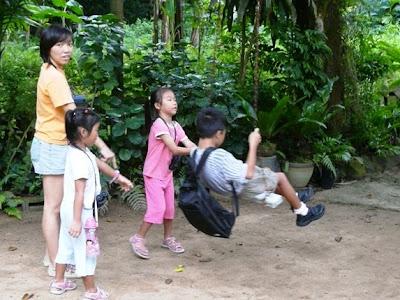 The courtyard swing had immediate takers.
According to Wikipedia, Kampong Buangkok was established in 1956 by Mr Sng Teow Koon, the father of Ms Sng Mui Hong, who continues to live here with her nieces while her three other siblings (who are co-owners) have longed moved out. Mr Sng started by renting out land for people to build homes. By the 1960s, Kampong Buangkok housed some 40 families, with residents paying just $2 to $3 in monthly rent. Its land area has since shrunk from 21,460 m2 to 12,248 m2. Today, the Kampong is home to 28 families (18 Chinese and 10 Malays), who are mostly elderly residents, workers and even a make-up artist. Rental is still kept at a nominal $13 and these folks continue to enjoy the slower pace of life typical of a kampong existence.
As Kampong Buangkok is in a low-lying area, it is still affected by flash floods, especially when heavy rains coincide with high tides. We were greeted by a signboard detailing the week’s high tides written in red ink, which stood prominently at the entrance along Lorong Buangkok. As our group wandered amongst the many fascinating facets of kampong life, the children played a game in which they had to act out parts depicting the buildings, plants, birds and insects encountered.
 What is a kampong without lush vegetation?
 Ms Sng Mui Hong, owner of Kampong Buangkok.
& Benjamin Ho of The Nature Ramblers
Photos by Lena Chow and Timothy Pwee
A Sunday morning romp through the last surviving kampong (village) in mainland Singapore proved to be an irresistible proposition for some 40 kids together with their parents/caregivers. We crossed the bridge at Sungei Punggol (a canalized river) on 29 November 2009, and stepped gingerly onto the wide dirt track leading up to Kampong Buangkok, not quite knowing what to expect. Would this ‘kampong’ be a gimmicky and tacky village like so many of Singapore’s artificial attractions? Or would it be truly reminiscent of the kampong of yore: a somewhat messy cluster of wooden houses crowned with zinc roofs?
Uncle Ben calls the troops to order.
We were pleasantly surprised when Kampong Buangkok turned out to be a quaint little hamlet hidden in the midst of modernity, only a stone’s throw from buzzing Buangkok HDB estate and the private houses off Yio Chu Kang Road. Our little adventure was led by Uncle Ben of The Nature Ramblers, who was all geared up to transport the kids back in time, showing them how many of our forefathers lived before the advent of government flats.
The courtyard swing had immediate takers. According to Wikipedia, Kampong Buangkok was established in 1956 by Mr Sng Teow Koon, the father of Ms Sng Mui Hong, who continues to live here with her nieces while her three other siblings (who are co-owners) have longed moved out. Mr Sng started by renting out land for people to build homes. By the 1960s, Kampong Buangkok housed some 40 families, with residents paying just $2 to $3 in monthly rent. Its land area has since shrunk from 21,460 m2 to 12,248 m2. Today, the Kampong is home to 28 families (18 Chinese and 10 Malays), who are mostly elderly residents, workers and even a make-up artist. Rental is still kept at a nominal $13 and these folks continue to enjoy the slower pace of life typical of a kampong existence.
As Kampong Buangkok is in a low-lying area, it is still affected by flash floods, especially when heavy rains coincide with high tides. We were greeted by a signboard detailing the week’s high tides written in red ink, which stood prominently at the entrance along Lorong Buangkok. As our group wandered amongst the many fascinating facets of kampong life, the children played a game in which they had to act out parts depicting the buildings, plants, birds and insects encountered.
 What is a kampong without lush vegetation?
 Kampong mongrels welcomed us with wagging tails. The kids were excited when they spotted a wooden coop, crowding around to look at the clucking chickens held within. Some parents were tempted to buy biscuits from a sparsely-stocked ‘provision shop’, but it turned out to be part of a movie set. Kids saw how kampong houses were built simply from wooden planks punctuated with ventilation holes, and painted in an assortment of colours, some as outlandish as pink. And yes, the houses were crowned with zinc roofs.
 Ms Sng Mui Hong, owner of Kampong Buangkok.
 Dirt tracks linked the various homes, lined with fruit trees like coconut, rambutan and banana, and fragranced by the presence of pandan and lemon grass. The calls of caged merboks, bulbuls and mata putehs added to the relaxing soundscape. Most homes were ragtag spartan and suitably messy, some sporting outdoor kitchens with utensils strung out in rows. However one house, tucked in an obscure corner, was downright pretty, with a porch featuring Balinese-style wooden doors capped with charming metallic motifs, inviting teak furniture and other cosy decorations.
 The street sign here still uses the four-digit postal code!
Amongst the verdant vegetation, we found birds like the Black-naped Oriole, Asian Glossy Starling, Laced Woodpecker and Peaceful Dove. Aside from hearing the calls of cicadas, the kids were treated to sightings of butterflies, bees and grasshoppers. The walk concluded with a short trek along Sungei Punggol which runs alongside the Kampong, where we caught glimpses of the Blue-tailed Bee-eater and Collared Kingfisher.
 The street sign here still uses the four-digit postal code!
Tuesday, 27 October 2009
Upcoming: Fun with Kampong Games (NSS members only)
Date: 28 November 2009 (Saturday)
at the NSS Get-Together held at the same venue
Time: 4.30pm to 6 pm.
Venue: MOE Dairy Farm Adventure Center
Cost: Free-of-Charge, for kids of NSS members only
Sign Up: Please email Gloria at gloria_seowATyahoo.com
Calling all kids 4 to 12 years old. Join Gloria and Tim of the NSS Education Group in Fun with Kampong Games, in a repeat of last year's kids' activities at the NSS Get-Together. Shoot marbles, dabble in ‘five stones’ and enjoy team games such as ‘Eagle catches the Chicks’, ‘One-Leg’ and ‘Le-long’. Register with Gloria at gloria_seowATyahoo.com stating your kids’ names and ages.
at the NSS Get-Together held at the same venue
Time: 4.30pm to 6 pm.
Venue: MOE Dairy Farm Adventure Center
Cost: Free-of-Charge, for kids of NSS members only
Sign Up: Please email Gloria at gloria_seowATyahoo.com
Calling all kids 4 to 12 years old. Join Gloria and Tim of the NSS Education Group in Fun with Kampong Games, in a repeat of last year's kids' activities at the NSS Get-Together. Shoot marbles, dabble in ‘five stones’ and enjoy team games such as ‘Eagle catches the Chicks’, ‘One-Leg’ and ‘Le-long’. Register with Gloria at gloria_seowATyahoo.com stating your kids’ names and ages.
Subscribe to:
Posts (Atom)