Tuesday, 6 April 2010

NSS Kids’ Fun with Butterflies at Changi Airport T3

This activity is open to NSS members only.
Date: 25 April 2010, Sunday
Time: 9.30 am to 11.30 am
Venue: Changi Airport Terminal 3
Closing Date: 14 April 2010

Do you know that the world's first butterfly garden in an airport is right here at Changi Airport Terminal 3? Located at the Transit Mall, this nature retreat is home to nearly 50 butterfly species native to Singapore and Malaysia, boasting more than 1,000 free-flying beauties. The garden has educational corners as well as individual enclosures where visitors can observe up close the breeding and feeding of butterflies. If you are lucky, you might even witness butterflies leaving their pupae! Gan and Simon of the Butterfly Interest Group will guide us. Limited to 16 places with priority given to NSS Kids between 4 to 12 years old. Depending on availability, parents may or may not be able to accompany your kids into the garden.

Particulars needed by Changi Airport (of parents and all children): a) Full Name as in NRIC/FIN, b) Gender, c) Race, d) Nationality, e) Country of Birth, f) Date of Birth (DD/MM/YY), g) Home/Company Address, h) Handphone Number, i) NSS membership number. Please email these particulars to Gloria at gloria_seow@yahoo.com. Closing date: 15 April 2010. A fee of $5 per participant (members only) will be collected on the spot. Please note that the date for this walk can only be confirmed after SATS police approve of the participant list. We will email you to confirm this, and to provide further details.

Wednesday, 6 January 2010

NSS Kids’ Fun with Migratory Birds at Ubin

Date: 20 Feb 2010, Saturday
Time: 8 am to 10.30 am.
Venue: Pulau Ubin
Registration: Please register your kids (4 to 12 years old) with Gloria at gloria_seowATyahoo.com

The migratory season is here, and we’ll be checking out Pulau Ubin to see which birds have landed! Our feathered friends migrate to warm places like Singapore in the northern autumn and winter, which is typically from October to March in any given year. We also hope to spot resident birds like the charismatic Oriental Pied Hornbill and more as we stroll around the idyllic island. Our trip will end at the NSS Ubin House, right in the heart of Ubin village, which brims with nature paraphernalia, where we'll have a little quiz with prizes to be won. Time: 8 am to 10.30 am. Please register your kids (4 to 12 years old) with Gloria at gloria_seow@yahoo.com, stating their names and ages, if you are a NSS member or not, your mobile number, and if you need us to loan you binoculars or not. A fee of $5 per child (member) or $10 per child (non-member) will be collected on the spot. Parents are encouraged to come along at no charge. Details will be emailed to those who sign up.

Tuesday, 22 December 2009

NSS Kids’ Last Kampong of Singapore Adventure

By Gloria Seow, Education Group Chairperson
& Benjamin Ho of The Nature Ramblers
Photos by Lena Chow and Timothy Pwee

A Sunday morning romp through the last surviving kampong (village) in mainland Singapore proved to be an irresistible proposition for some 40 kids together with their parents/caregivers. We crossed the bridge at Sungei Punggol (a canalized river) on 29 November 2009, and stepped gingerly onto the wide dirt track leading up to Kampong Buangkok, not quite knowing what to expect. Would this ‘kampong’ be a gimmicky and tacky village like so many of Singapore’s artificial attractions? Or would it be truly reminiscent of the kampong of yore: a somewhat messy cluster of wooden houses crowned with zinc roofs?


Uncle Ben calls the troops to order.

We were pleasantly surprised when Kampong Buangkok turned out to be a quaint little hamlet hidden in the midst of modernity, only a stone’s throw from buzzing Buangkok HDB estate and the private houses off Yio Chu Kang Road. Our little adventure was led by Uncle Ben of The Nature Ramblers, who was all geared up to transport the kids back in time, showing them how many of our forefathers lived before the advent of government flats.

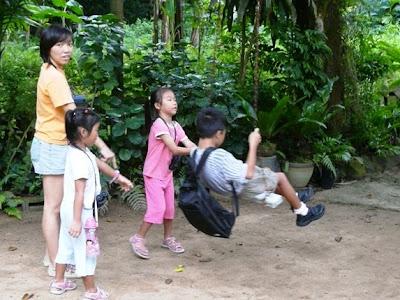
The courtyard swing had immediate takers.

According to Wikipedia, Kampong Buangkok was established in 1956 by Mr Sng Teow Koon, the father of Ms Sng Mui Hong, who continues to live here with her nieces while her three other siblings (who are co-owners) have longed moved out. Mr Sng started by renting out land for people to build homes. By the 1960s, Kampong Buangkok housed some 40 families, with residents paying just $2 to $3 in monthly rent. Its land area has since shrunk from 21,460 m2 to 12,248 m2. Today, the Kampong is home to 28 families (18 Chinese and 10 Malays), who are mostly elderly residents, workers and even a make-up artist. Rental is still kept at a nominal $13 and these folks continue to enjoy the slower pace of life typical of a kampong existence.

As Kampong Buangkok is in a low-lying area, it is still affected by flash floods, especially when heavy rains coincide with high tides. We were greeted by a signboard detailing the week’s high tides written in red ink, which stood prominently at the entrance along Lorong Buangkok. As our group wandered amongst the many fascinating facets of kampong life, the children played a game in which they had to act out parts depicting the buildings, plants, birds and insects encountered.

What is a kampong without lush vegetation?

Kampong mongrels welcomed us with wagging tails. The kids were excited when they spotted a wooden coop, crowding around to look at the clucking chickens held within. Some parents were tempted to buy biscuits from a sparsely-stocked ‘provision shop’, but it turned out to be part of a movie set. Kids saw how kampong houses were built simply from wooden planks punctuated with ventilation holes, and painted in an assortment of colours, some as outlandish as pink. And yes, the houses were crowned with zinc roofs.


Ms Sng Mui Hong, owner of Kampong Buangkok.

Dirt tracks linked the various homes, lined with fruit trees like coconut, rambutan and banana, and fragranced by the presence of pandan and lemon grass. The calls of caged merboks, bulbuls and mata putehs added to the relaxing soundscape. Most homes were ragtag spartan and suitably messy, some sporting outdoor kitchens with utensils strung out in rows. However one house, tucked in an obscure corner, was downright pretty, with a porch featuring Balinese-style wooden doors capped with charming metallic motifs, inviting teak furniture and other cosy decorations.

The street sign here still uses the four-digit postal code!

Amongst the verdant vegetation, we found birds like the Black-naped Oriole, Asian Glossy Starling, Laced Woodpecker and Peaceful Dove. Aside from hearing the calls of cicadas, the kids were treated to sightings of butterflies, bees and grasshoppers. The walk concluded with a short trek along Sungei Punggol which runs alongside the Kampong, where we caught glimpses of the Blue-tailed Bee-eater and Collared Kingfisher.

Tuesday, 27 October 2009

Upcoming: Fun with Kampong Games (NSS members only)

Date: 28 November 2009 (Saturday)
at the NSS Get-Together held at the same venue
Time: 4.30pm to 6 pm.
Venue: MOE Dairy Farm Adventure Center
Cost: Free-of-Charge, for kids of NSS members only
Sign Up: Please email Gloria at gloria_seowATyahoo.com

Calling all kids 4 to 12 years old. Join Gloria and Tim of the NSS Education Group in Fun with Kampong Games, in a repeat of last year's kids' activities at the NSS Get-Together. Shoot marbles, dabble in ‘five stones’ and enjoy team games such as ‘Eagle catches the Chicks’, ‘One-Leg’ and ‘Le-long’. Register with Gloria at gloria_seowATyahoo.com stating your kids’ names and ages.

Upcoming: “Last Kampong of Singapore” Adventure

Suitable for children 4 to 12 years old
Date: 29 November 2009 (Sunday)
Time: 8.30 am to 10.30am.
Cost: A fee of $5 per child (NSS member) or $10 per child (non-member) will be collected on the spot.
Sign Up: Pls email
gloria_seowATyahoo.com

Travel back in time with Benjamin Ho of The Nature Ramblers when we visit the last surviving village in mainland Singapore at Kampong Lorong Buangkok. Even though it is only a stone’s throw from buzzing Hougang HDB estate, the idyllic calls of bulbuls, cicadas and kingfishers fill the air, while the smells of fresh kampong produce like ginger, lemongrass and pandan pervade. Experience what it is like living in a rustic wooden hut with zinc roof, surrounded by banana, chiku and rambutan trees with a river right at your doorstep. Time: 8.30 am to 10.30am. Please register your kids (4 to 12 years old) with Gloria at
gloria_seowATyahoo.com, stating their names and ages, if you are a NSS member or not, your mobile number, and if you need us to provide binoculars or not. A fee of $5 per child (member) or $10 per child (non-member) will be collected on the spot. Parents are encouraged to come along at no charge. Details will be emailed to those who sign up.

NSS Kids’ Fun at Kranji Marsh

By Gloria Seow, Education Group Chairperson
Nature Society (Singapore)


Briefing of the excited kids and their parents.

Kranji Marsh (Reservoir) is NSS newest conservation baby ever since we adopted it under the PUB’s ABC Waters Programme in 22 November 2008. Located at the end of Neo Tiew Lane 2, this waterbody became the ecological adventure grounds for a merry band of NSS kids and their family on 19 September 2009.

Auntie Gloria exhorted everybody to stay on the main path, so as to minimise unpleasant encounters with Black Spitting Cobras and reduce the chance of brushing against hornet’s and bee’s nests, which typically hang low on trees and shrubs. Right away, one of the kids shrieked in terror as he spied a buzzing bee on another child’s clothes. Auntie Gloria had to inject some calm by telling the surrounding kids not to panic, and to leave the bee alone as it would likely fly away on its own. The last thing to do is to smash a bee or hornet as the crushed insect would release powerful distress pheromones (chemical) that would incite other nearby stingers to attack with fearless tenacity. Another kid suggested that we fumigate the place to get rid of such nests, but we explained that hornets and bees have a place in the ecosystem and a right to live, just like us.


Uncle Anuj points out the spongy roots of the Water Banana.
Uncle Morten and Uncle Timothy then scoped a small flock of Long-tailed Parakeets with shimmering green feathers and rosy cheeks for the kids. Next, we proceeded to the pond, which was in the process of being cleared of its excessive vegetation to create an open water area conducive to fowl like the Lesser and Wandering Whistling Ducks. Uncle Anuj, our guide for Kranji Marsh, introduced the Apple Snail and its pink eggs, and pointed out floating marsh plants like the Kang Kong (Water convolvulus) vegetable. Such plants have body parts adapted to floatation, mainly by trapping air. For example, the Kang Kong has a hollow stem, the Water Banana has spongy banana-shaped roots, while the Water Hyacinth has bulbous air-trapping stems.
Uncle Anuj revealed that these marshy plants are part of PUB’s water treatment process as their roots naturally absorb heavy metal pollutants such as lead, zinc, manganese and copper in concentrations 10,000 times that of the surrounding waters. PUB regularly clears away old vegetation. If they are allowed to die in situ, the poison absorbed would be released back into the waters.
The pink eggs of the Apple Snail are commonly found stuck onto plants.


A poor injured eel provided lots of excitement.
At the far end of the pond, somebody spotted what looked like a black snake, only that it had smooth skin with no scales, and its body was half submerged in water. Auntie Gloria and Uncle Timothy identified it as an eel, and we realised that part of its head was missing, as if chomped upon by a big snakehead, or cut off by a rotor blade. The eel, with pink raw flesh showing and one eye missing, occasionally wriggled its body and opened its voluminous mouth to gulp air. Some were repelled by this grotesque sight. Others were thrilled to see a freshwater eel, many for the first time.

A boy looking through the scope to see upclose the shimmery green feathers of the native Long-tailed Parakeet.

Scenic walk along the Kranji Bund where we saw plenty of fishing White-winged and Little Terns.

Our group then walked along the scenic Kranji Bund, which is off limits to the general public. Over here, we saw plenty of fishing Little and White-winged Terns, Pacific Swallows, as well as an Intermediate Egret. Many were spooked by the ‘Caution: Crocodile Spotted’ sign at the start of the Bund, which also triggered a whole spate of imaginary crocodile sightings by the very imaginative kids. The darkening skies drove us back to our cars, just in time to avoid being drenched by the late morning showers.

This sign triggered a whole spate of imaginary crocodile sightings.

Tuesday, 14 July 2009

Upcoming: Fun with Colourful Crabs at Chek Jawa

Date: Sunday 26 July 2009
Time: 8am - 11 am
Location: Chek Jawa, Pulau Ubin. Meet at Changi Point Ferry Terminal (next to Changi Village)
Coordinator: Gloria Seow. Register at gloria_seow AT yahoo.com

Colourful pincers waving in the air, feeding crabs are everywhere. Plenty of multi-coloured fiddler crabs colonise the mangroves and beaches of Chek Jawa (Pulau Ubin), clothed in electrifying colours if you care to look closely. Help Tan Hang Chong and Timothy Pwee spot these tiny crustaceans and learn fascinating facts like how their burrowing promotes nutrient cycling. We will also get to observe the much talked about marine life of Chek Jawa which will be exposed during the low tides. Meet at 8 am at the Changi Point Ferry Terminal. You will need to bring $9 per person to cover the return ferry fares to Pulau Ubin ($5) and the return van ride to Chek Jawa ($4), excluding registration fees. Please register your kids (4 to 12 years old) with Gloria at gloria_seowATyahoo.com, stating their names and ages, if you are a NSS member or not, your mobile number, and if you need us to provide binoculars or not (to see the tiny crabs). A fee of $5 per child (member) or $10 per child (non-member) will be collected on the spot. Parents are encouraged to come along at no charge. Details will be emailed to those who sign up.

Fun with Plants that Grow on Other Plants

By Gloria Seow, Education Group Chairperson

Margie explained the difference between epiphytes and parasites to kids and their parents.

Margie Hall’s black-and-white bungalow in Sembawang was the perfect place to view plants that grow on other plants (known as epiphytes and parasites) as they flourish at eye level in her lush garden. Kids had an enjoyable morning touring this little Eden on 6 June 2009 to gawk at the fascinating array of mistletoes, ferns, fungi, mosses, lichens and orchids that festooned the branches and trunks of various trees and shrubs. The Wrightea plant was festooned with semi-parasitic mistletoes.

So what’s the difference between epiphytes and parasites? Epiphytes use the host plant as support only (to reach the sunlight), while parasites not only use the host plant as support, but take food and water from it as well.

Margie’s cutters snipped through the mistletoe’s haustorium (the connection of the mistletoe with the Wrightea) and lots of ants started pouring out!

Kids saw how several types of local mistletoes Dendropthoe, Macrosolen and Viscum, considered semi-parasites, almost snuffed out the life of their host plant the Wrightea in Margie’s garden, by stealing food, water and sunlight from it. They learnt how the Scarlet-backed Flowerpecker played a part in this process – this tiny bird eats the mistletoe berries whole, but excrete the undigested seeds as sticky dung on the Wrightea’s branches, which germinate into more invasive mistletoes. The poor Wrightea was not only heavy laden with these plant semi-parasites, but even had mistletoes parasitizing on other mistletoes growing on it! As a result, its leaves were much smaller than their usual size and the Wrightea was slowly dying. Margie then cut off some branches with mistletoes on them, snipping through the roots and cross-section of the haustorium (the connection of the mistletoe with the Wrightea). Lots of ants began to pour out – apparently the spaces between the roots, haustorium and Wrightea branches were also cosy ant houses!

Luxuriant Oak-leaf and Rabbit’s-foot ferns.

We had various non-plant diversions, like hearing the tantalizing song of the Straw-headed Bulbul, one of the kids finding the moult of a cicada, admiring pretty butterflies as they weaved in and out of flowers, and best of all, observing the tree-hole nest of the Coppersmith Barbet through the scope, thanks to the sharp eyes of Morten Strange, author of numerous bird books, who was there with his son Mark.

Eight-year old Tristan Tan had fun chalk drawing his mistletoe.

Margie’s driveway then became a huge drawing board when kids were invited to sketch their favourite epiphytes and parasites with coloured chalks. Soon enough, the black bitumen was full of cutesy doodles. Kids being kids, they could not help but play tic-tac-toe and draw stuff like a mile-long caterpillar too!

The driveway covered in chalk doodles.

Monday, 25 May 2009

Upcoming: Fun with Plants that Grow on Other Plants


Date: Sat 6 June 2009
Time: 8am - 10am
Location: Black-and-White Bungalow near Sembawang Park
Coordinator: Gloria Seow. Register at gloria_seow AT yahoo.com

Do you know that Singapore has several of our own species of wild mistletoes (yes, the same one that people kiss under during Christmas) that typically grow on the branches of tall trees? Learn about mistletoes and other plants that grow on trunks and branches (ie. epiphytes and parasites), and see them flourishing wild at eye-level in the garden of a classic black-and-white bungalow near Sembawang Park. Margie Hall, NSS Honorary Secretary and professional nature guide, whose house we would be visiting, will personally give us a fun-filled introduction to these fascinating plants, with insights to their peculiar survival strategies. Please register your kids (4 to 12 years old) at gloria_seow AT yahoo.com, stating their names and ages, if you are a NSS member or not, your mobile number, and if you need us to provide binoculars or not. A fee of $5 per child (member) or $10 per child (non-member) will be collected on the spot. Parents can sit in at no charge. Details will be emailed to those who sign up.


Tuesday, 14 April 2009

Fun at Lower Pierce Reservoir

By Leshon Lee, 12-year old Nature Guide

It was one of the most memorable trips I have ever guided. My little audiences, the children present on 29 March 2009 for my botany and wildlife walk at the Lower Pierce Reservoir, were both knowledgeable and inquisitive. Auntie Gloria and the Education Group led a simultaneous birding session with helpers like Uncle Si Guim, Auntie Lena, Uncle Benjamin and Auntie Luyan.

Barely taller than the children he guided, Leshon gave a briefing before we started out. Photo by Goh Si Guim.

It was quite a squeeze on the boardwalk that snaked through the forest. Photo by Gloria Seow.

We started off at the Casuarina entrance of the Lower Pierce boardwalk, strolling along the Hevea Trail where I pointed out plants like the spiny-trunked Nibong (Oncosperma tigillarium), and talked about its traditional use as construction material for fishing stakes in kelongs, once the trunks have been stripped of their black spines. We also came across the Fishtail Palm (Caryota mitis), which has leaflets shaped like fishtails, looking as if they had been eaten before by some animal. This is the plant’s defense strategy against herbivores, as typically, animals avoid eating leftovers too! This palm also has a unique flowering pattern – the first flowering cluster emerges at the top of a mature palm, with subsequent clusters appearing below this level and so on. After the final flowering cluster, which sprouts near the ground, the palm dies.

The kids learnt about how the Nibong can be stripped of its spines to be used as construction material for fishing stakes in kelongs. Photo by Leshon Lee.

A spider breakfasting on a juvenile forest cockroach. Photo by Gloria Seow.

Lots of kids were inspired by Leshon's nature knowledge. Photo by Gloria Seow.

We emerged from the forested trail to the scenic views of the Lower Pierce Reservoir where the boardwalk continued along the water edge. Over here, Auntie Gloria and the other guides pointed out birds like soaring White Bellied Sea Eagles and Brahminy Kites, and showed the kids through the scope, close-up views of an Oriental Honey Buzzard, a Purple Heron, Blue-tailed Bee Eaters, and the highlight of a Changeable Hawk Eagle at its nest, first spotted by Uncle Si Guim. We were indeed lucky to find four raptors in one morning!

We also passed mischievous Long-tailed Macaques and Plantain Squirrels scurrying along the trees, observed a jumping spider and its leaps, and witnessed another spider breakfasting on a juvenile forest cockroach. All in all, we had a wonderful time.

Leshon, possibly Singapore's youngest nature guide, with his 500mm camera around his neck. Photo by Lena Chow.